
Ask ten business owners what digital transformation for businesses actually means, and you’ll get ten different answers.
A retail shop might picture finally moving customer records out of a notebook and into the cloud. A professional services firm might think of a website that actually generates leads instead of sitting there like a digital business card. Meanwhile, a growing manufacturer might just want to replace three disconnected spreadsheets with one system everyone can see.
That’s the strange thing about digital transformation for businesses: everyone agrees it matters, but almost no one agrees on what it looks like in practice.
Here’s what we’ve learned working with businesses going through this shift: it was never really about the technology. Buying more software doesn’t make a company “transformed” — it just makes it more crowded. The businesses that actually pull this off are the ones that use technology to fix how work actually gets done: how they communicate, how they market themselves, how they serve customers, and how they grow without everything getting more complicated along the way.
This guide walks through what digital transformation means in 2026, why it’s become urgent rather than optional, where most businesses should start, and how tools like website development, Google Workspace for business, SEO, social media marketing, and automation fit together — not as separate purchases, but as one connected system.
What’s Inside This Guide
- What Is Digital Transformation?
- Why Digital Transformation Matters in 2026
- Digital Transformation Is Not Just About Technology
- The 8 Areas of Digital Transformation Every Business Should Review
- The Most Important Digital Transformation Tools for Businesses
- How Website Development Fits Into Digital Transformation
- How Google Workspace Supports Digital Transformation
- How SEO Supports Digital Transformation
- How Social Media and SEO Work Together
- What Is an Integrated Digital Business?
- Why Businesses Should Avoid Disconnected Digital Tools
- 10 Signs Your Business Needs Digital Transformation
- Digital Transformation for Small Businesses
- Digital Transformation for Growing Businesses
- How to Create a Digital Transformation Strategy
- A Simple 90-Day Digital Transformation Roadmap
- How Much Does Digital Transformation Cost?
- Common Digital Transformation Mistakes
- How to Know If Your Digital Transformation Is Working
- Digital Transformation Is a Continuous Process
- The Role of an IT Services Company in Digital Transformation
- Why Integrated Digital Services Matter
- Digital Transformation Across Different Industries
- Digital Transformation in the Philippines
- How to Start Your Digital Shift Today
- The Digital Shift Is Now
- Frequently Asked Questions
What Is Digital Transformation?
At its core, digital transformation is the process of using digital technology to change how a business operates, communicates, markets itself, serves customers, and grows. It sounds simple. It isn’t — because most people stop at “using technology” and miss the harder part: improving the work itself.
For example, picture a company fielding customer inquiries from five different channels. The old way usually looks something like this:
Customer inquiry → Email or Messenger → Employee replies → Spreadsheet → Manual follow-up (if anyone remembers to do it)
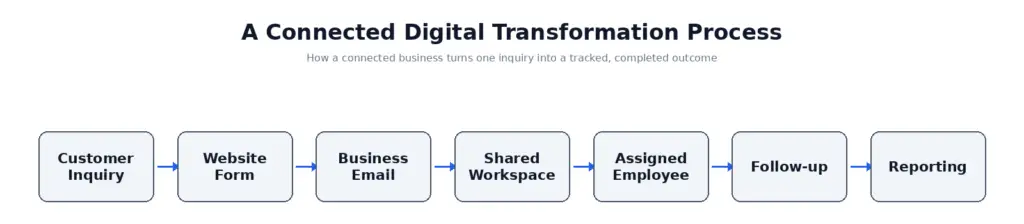
A digitally transformed version of that same process looks more like this:
Customer inquiry → Website form → Business email → Shared workspace → Assigned employee → Follow-up → Reporting
Notice what changed. It’s not really the technology — a form and an email aren’t exotic tools. What changed is the process: nothing falls through the cracks, nobody has to remember to check three different apps, and the business can actually see what’s happening.
That’s the real starting point for any business considering this path. Before buying anything, ask:
- What can be improved?
- What can be digitized?
- What can be automated?
- What should be connected?
- What information should be easier to find?
- How can customers have a better experience?
Answer those honestly, and you’ve already done more strategic thinking than most companies do before they sign a software contract.
Why Digital Transformation Matters in 2026
Here’s a number worth sitting with: according to the OECD’s 2025 SME Digitalisation for Competitiveness survey, which looked at businesses across Australia, Germany, the United Kingdom, and the United States, digitalisation is now a defining factor in how well small and mid-sized companies compete, reach new markets, and operate efficiently — while limited resources, skills gaps, and digital security concerns remain the biggest things holding them back.
That last part matters more than the first. Big companies have the luxury of dedicated IT departments, in-house developers, and marketing teams working in parallel. Most small and medium-sized businesses don’t have that luxury — often it’s two or three people wearing five hats each. So every hour lost to a clunky process, a missed lead, or a scattered filing system hurts more than it would at a larger company.
That’s the real argument for digital transformation in 2026. It’s not about chasing shiny new tools. It’s about getting more value out of the hours your team already has — cutting repetitive work, tightening collaboration, generating better leads, and making information easy to find, without needing some huge, complicated tech stack to do it.
Digital Transformation Is Not Just About Technology
Here’s a misconception worth killing early: digital transformation does not mean “buy new software.”
A company can have two dozen apps installed and still be a mess. In fact, you’ve probably seen this yourself — files scattered across five different drives, half the team using WhatsApp and the other half using email, customer information nobody can find on demand, a website that hasn’t generated a single inquiry in months, marketing and sales working from entirely different playbooks, reports stitched together by hand every week, and employees quietly repeating the same manual task every single day.
That business is using technology. It is not digitally connected. In other words, those are two very different things.
Real transformation only happens when three things move together:
People. Your team actually has to understand and use the systems you give them — otherwise you’ve just built an expensive shelf decoration.
Processes. Your workflows need to be organized and improved before you bolt technology onto them.
Technology. Your tools need to genuinely support the people and processes already in motion — not the other way around.
Once all three move in the same direction, even simple tools start punching well above their weight.
The 8 Areas of Digital Transformation Every Business Should Review
A serious digital transformation strategy doesn’t cherry-pick one department and call it done — it looks at the whole business, because real digital transformation for businesses touches every corner of how a company runs. Here are the eight areas worth auditing.
1. Digital Workplace and Collaboration
First, consider the basics: how does your team actually communicate and share information day to day? Do employees have professional business email? Can they share files through one central system instead of five personal drives? Can they collaborate on the same document in real time, hold online meetings, and work securely no matter where they’re sitting?
A well-built digital workplace lets employees work together without needing to share a physical office. Cloud collaboration platforms such as Google Workspace for business bundle business email, file storage, documents, spreadsheets, meetings, and calendars into one connected environment — so the goal isn’t “give employees more apps,” it’s giving them fast access to the information and tools they need to actually get work done.
2. Website and Digital Presence
For most businesses, the website is the very first impression a prospective customer forms — often before they’ve spoken to a single human being at your company. That means a website should do far more than sit there displaying your logo and phone number.
A modern business website should explain your services clearly, build credibility, generate leads, collect inquiries, publish genuinely useful content, support SEO, promote your products, answer the questions customers are already asking, and point visitors toward a next step. Done right, it becomes part of your sales process, not just a digital brochure:
Google search → Website → Service page → Inquiry form → Business email → Sales follow-up
That’s a fundamentally more valuable asset than a static page nobody updates.
3. Search Engine Optimization
Naturally, none of that matters if nobody can actually find your website. That’s where SEO comes in.
Search engine optimization improves your visibility for the searches your future customers are already typing — things like “IT services company,” “website development company,” “Google Workspace consultant,” “SEO services,” “social media management,” or “business automation services.” The goal was never to rank for keywords for their own sake. It’s to attract people who have a real, immediate need for what you offer. Built well, SEO becomes a long-term, compounding source of website traffic that doesn’t switch off the moment you stop paying for ads.
4. Social Media Marketing
Social media marketing builds awareness and relationships in a way search alone can’t — it lets you promote your services, educate your audience, share updates, build trust, demonstrate expertise, and drive traffic back to your site.
But social media performs far better when it isn’t operating in isolation. A stronger structure looks like this:
Social media → Website → Content → Service page → Inquiry
Imagine a LinkedIn post about business automation that sends readers to an article explaining exactly how to automate repetitive processes — and that article then points them toward your automation or IT services page. Now every post is doing double duty: building your brand and quietly feeding your funnel.
5. Business Automation
Automation means using technology to cut down on repetitive manual work — and no, that doesn’t automatically mean replacing people. Done well, it usually means the opposite: freeing employees from the mind-numbing repetitive stuff so they can spend their time on the work that actually needs judgment, creativity, or a human touch.
Think automated inquiry forms, email notifications, document workflows, calendar scheduling, lead tracking, digital approvals, reporting, customer follow-ups, social workflows, and structured data collection.
One caution worth repeating: don’t automate a broken process. Fix the process first — otherwise, automating chaos just gets you chaos at a faster speed.
6. Data and Information Management
Every business runs on information — customer data, financials, marketing numbers, employee records, project details, operational metrics. When that information is scattered across personal laptops, buried in email attachments, or split across a dozen spreadsheets, it becomes nearly impossible to manage well.
Digital transformation should give you centralized information, organized folders, clear access controls, shared documents, consistent naming conventions, faster reporting, and easier collaboration. Essentially, the goal is simple: put the right information in front of the right person at the right moment — not three email threads later.
7. Digital Customer Experience
Customers expect to be able to reach you easily, whether they found you through Google, social media, your website, email, an online directory, or a referral. Whichever door they walk through, the experience needs to feel consistent.
A customer spots your social page, clicks through to your website, reads about your service, submits an inquiry, your team receives it, and someone actually follows up. Ideally, that entire chain should feel like one continuous conversation — not five disconnected systems that happen to be owned by the same company. Digital transformation should improve that customer-facing experience just as much as it improves what happens behind the scenes.
8. Security and Business Continuity
The more information a business stores digitally, the more it has to protect. Security shouldn’t be the thing you bolt on after something goes wrong — it belongs in the foundation from day one.
That means paying attention to account security, password management, access permissions, regular data backups, employee access controls, device security, business email protection, recovery procedures, and ongoing staff training. Think of it as insurance for everything else on this list — because none of the other seven areas matter much if a single breach wipes it all out.
The Most Important Digital Transformation Tools for Businesses
There’s no universal tech stack that fits every company — but digital transformation for businesses of almost any size usually starts from a handful of core tools:
- Website development — your digital foundation
- Google Workspace for business — your collaboration environment
- SEO — your long-term search visibility engine
- Social media marketing — your awareness and engagement channel
- Automation — your way of cutting repetitive work and connecting processes
On their own, each of these delivers value. Together, however, they multiply each other’s impact.
How Website Development Fits Into Digital Transformation
It’s tempting to treat website development as purely a design exercise — pick a template, choose some colors, done. But a website earning its keep needs to do more than look good.
A strong website drives awareness (customers discover you), education (they learn what you actually do), conversion (they submit an inquiry), communication (your team receives and responds), and marketing (it supports your SEO, content, and campaigns). As a result, website development becomes less of a one-off project and more of a permanent piece of your digital business system.
Every good website, at minimum, should answer three questions almost instantly: What does your business do? Why should a customer choose you over the next search result? And what should they do right now?
How Google Workspace Supports Digital Transformation
Google Workspace for business can effectively become your company’s digital workplace — bringing business email, cloud storage, documents, spreadsheets, presentations, video meetings, calendars, forms, and team communication under one roof.
Instead of employees juggling disconnected personal files, you get shared systems that actually talk to each other: Google Drive centralizes your files, Google Docs lets teams collaborate on the same document in real time, Google Sheets turns reporting into something everyone can see at once, Google Meet handles online meetings, Google Calendar keeps scheduling sane, and Gmail carries your professional communication.
However, here’s the catch — simply subscribing to Google Workspace isn’t the same as transforming anything. The value only shows up once the system is actually implemented in a way that fits how your specific team works.
How SEO Supports Digital Transformation
Most people file SEO under “marketing.” Fair enough — it is marketing. But it’s also quietly one of the most powerful growth engines a business can build, because it meets customers at the exact moment they’re already looking for a solution.
Someone searching “how to automate customer inquiries,” “best Google Workspace setup for small business,” or “website development company” doesn’t know your company exists yet. If your website has genuinely useful content sitting there waiting for them, that search becomes your introduction. This is precisely why cornerstone content matters so much: instead of scattering random blog posts across your site, you build a deliberate network of content around the actual problems your customers are trying to solve.
How Social Media and SEO Work Together
SEO and social media aren’t competing strategies. Rather, they’re complementary ones playing different roles. SEO helps people discover your website through search. Social media lets you actively reach an audience before they’ve even started searching.
Put them together and you get something stronger than either alone:
Blog article → LinkedIn post → Facebook post → Website → Service page → Inquiry
A blog post titled “7 Business Processes You Should Automate” becomes a LinkedIn post asking “Are your employees still spending hours on repetitive tasks?” — which becomes a Facebook post pointing to those seven processes — which sends readers back to the article, into your services page, and eventually into your inbox as an inquiry. That’s what an integrated content strategy actually looks like in motion.
What Is an Integrated Digital Business?
An integrated digital business connects its tools and processes instead of running them as isolated silos:
Social media creates awareness → SEO captures search demand → Your website educates and converts visitors → Google Workspace helps the team collaborate → Automation cuts repetitive work → Sales and customer service follow up
Line it up like that, and you ultimately get a connected digital ecosystem rather than a pile of disconnected software subscriptions.
Why Businesses Should Avoid Disconnected Digital Tools
Here’s an uncomfortable truth: a business can own a website, run social media, subscribe to Google Workspace, invest in SEO, and set up automation — and still have a genuinely broken digital system. Why? Because none of it talks to each other.
Picture this scenario. Your marketing team generates a promising lead. Your website captures the inquiry. But nobody’s quite sure who’s supposed to follow up. The details get copied into a spreadsheet. That spreadsheet gets emailed to another employee. That employee forgets. The prospect quietly moves on to a competitor who responded faster.
The business had all the technology money could buy. The process was still broken. Digital transformation, done properly, exists specifically to close that gap.
10 Signs Your Business Needs Digital Transformation
Your business is likely overdue for digital transformation if:
- Employees spend too much time on repetitive tasks.
- Important files live across different devices with no central home.
- Your team relies heavily on personal email or messaging apps for business communication.
- Customer inquiries are hard to track once they come in.
- Your website generates little to no actual business.
- Customers struggle to find you online in the first place.
- Your social media and website operate as two separate worlds.
- Reports take hours to pull together instead of minutes.
- Employees regularly ask each other “wait, where is that file?”
- Your business has outgrown its own processes faster than it’s grown its headcount.
If several of those hit close to home, the answer usually isn’t “hire more people.” It’s “fix the process those people are stuck working around.”
Digital Transformation for Small Businesses
Small businesses face a different reality than large corporations — fewer resources, thinner teams, and often one person juggling marketing, sales, admin, customer service, and operations simultaneously. Which makes efficiency less of a nice-to-have and more of a survival skill.
The OECD notes that smaller businesses face real barriers to digitalisation, including limited resources, skills gaps, financial constraints, and simple lack of awareness of what’s even possible.
The good news: the answer isn’t an expensive enterprise software suite. A small business can build meaningful momentum with professional business email, cloud collaboration, a modern website, SEO, social media, and simple automation. Altogether, that combination already creates a solid digital foundation — no seven-figure transformation budget required.
Digital Transformation for Growing Businesses
Growth has a way of multiplying complexity. More customers, more employees, more files, more projects, more marketing, more communication — and inevitably, more room for something to slip through the cracks.
This is exactly where digital systems start pulling real weight. A growing business should be thinking about standardized workflows, centralized documents, clear user permissions, professional email, website lead generation, SEO, social media systems, automated notifications, digital reporting, data security, and business continuity planning. The goal isn’t complexity for its own sake — it’s building systems that can scale alongside the company instead of buckling under it.
How to Create a Digital Transformation Strategy
A real digital transformation strategy starts with your business’s actual problems — not with whatever software a vendor is currently pitching you.
Step 1: Identify Your Biggest Problems
What takes too much time? Where do employees keep making the same mistakes? Where do customers experience delays? What information is genuinely hard to find? Which tasks get repeated every single day? Where are leads quietly slipping away? Which processes fall apart the moment one specific employee is out sick? Write all of it down — nothing is too small to note.
Step 2: Map Your Existing Processes
Pick one important process — customer inquiries, for example — and document every single step. Who receives it first? Where does it get recorded? Who’s responsible for responding? How is it followed up? How does anyone report on the outcome? This alone usually reveals exactly where things are breaking.
Step 3: Prioritize
Don’t try to transform everything at once — indeed, that’s how transformation projects die. Focus first on processes that affect revenue, affect customers directly, eat up significant time, cause frequent errors, involve many employees, or can realistically be improved quickly.
Step 4: Choose the Right Tools
Only after you understand the actual process should you go shopping for technology — a website, Google Workspace for business, cloud storage, online forms, SEO tools, social platforms, automation tools, analytics, or project management systems.
Step 5: Implement Gradually
Start with one process. Improve it. Train your team properly. Measure what actually changed. Then move to the next one. Generally speaking, slower rollouts cause far less disruption than trying to flip every switch at once.
Step 6: Measure Results
Track time saved, leads generated, website traffic, search visibility, response times, customer inquiries, employee productivity, marketing engagement, and conversion rates. If technology isn’t producing measurable business value, something in the process still needs fixing.
A Simple 90-Day Digital Transformation Roadmap
If you’re not sure where to start, a simple three-stage plan works well.
Days 1–30: Audit. Take an honest look at your website, Google Workspace, business email, file storage, customer inquiries, marketing, SEO, social media, internal communication, and repetitive tasks. Narrow it down to your top three problems — no more.
Days 31–60: Improve. Start implementing fixes: improve the website, organize cloud files, standardize email practices, tighten up Google Workspace, kick off SEO improvements, build a real social media process, improve lead capture, and identify where automation could help.
Days 61–90: Connect. Start wiring the systems together — social media feeding into the website, the website capturing inquiries, inquiries routing into business email, email triggering a team workflow, the workflow ending in customer follow-up and reporting. That chain, once connected, is the beginning of a genuinely integrated digital business.
How Much Does Digital Transformation Cost?
There’s no single number here — the cost depends on business size, number of employees, existing technology, number of processes involved, website requirements, Google Workspace needs, SEO goals, marketing scope, automation complexity, and ongoing technical support requirements.
The better question isn’t “How much does digital transformation cost?” It’s “What does my business actually need to improve first?” A small business might only need a better website and professional email. A larger company might need a full digital workplace, an SEO strategy, social media management, workflow automation, and ongoing technical support. Digital transformation services should be scoped around what your business actually needs — not a one-size-fits-all package.
Common Digital Transformation Mistakes
Even well-intentioned transformation efforts go sideways. Here are ten of the most common ways that happens:
- Buying technology without a strategy. Technology should solve a specific problem — not just add another subscription to the pile.
- Trying to change everything at once. Start with the highest-impact processes, not all of them simultaneously.
- Ignoring employees. They’re the ones who’ll actually be using the new system every day.
- Focusing only on the website. A website needs content, SEO, marketing, and a real conversion process behind it — not just a fresh coat of paint.
- Treating social media as the entire digital strategy. It’s one important piece, not the whole puzzle.
- Treating SEO as a one-time project. It requires ongoing attention, not a “set it and forget it” mindset.
- Automating a broken process. Fix it first. Automate second.
- Ignoring security. Digital growth without proper security just creates new risk alongside new opportunity.
- Choosing too many tools. More software rarely equals more productivity — often it’s the opposite.
- Measuring activity instead of results. More apps isn’t the goal. Better business performance is.
How to Know If Your Digital Transformation Is Working
Real transformation should produce results you can actually point to. Worth tracking: how much time employees are genuinely saving, whether you’re reaching more relevant customers through marketing, whether search rankings and organic traffic are climbing, whether more website visitors are converting into inquiries, whether your sales pipeline is generating more qualified leads, whether customer service response times are improving, whether employees can find and share information faster, whether fewer tasks are being done manually, and whether decision-makers can actually access the information they need when they need it.
Over time, tracking those honestly turns digital transformation from a vague aspiration into something you can actually measure quarter over quarter.
Digital Transformation Is a Continuous Process
Going digital was never a project with a finish line — it doesn’t end the day you launch a new website or install new software. Technology keeps changing. Customer expectations keep shifting. Markets move. Consequently, your business changes right along with all of it, whether you plan for it or not.
A business that’s genuinely transforming keeps asking itself: what can we improve next? The answer might be SEO one quarter and automation the next. Other times it’s customer communication, data management, internal collaboration, or security that needs attention. The specific answer changes — the habit of asking doesn’t.
The Role of an IT Services Company in Digital Transformation
Most businesses don’t have the internal bandwidth to manage every layer of this alone — and that’s exactly where an IT services company earns its keep. A capable partner can help assess your actual needs, implement the right technology, improve existing systems, and provide ongoing support once things are live.
That matters even more when multiple digital services need to work together seamlessly. Rather than juggling one provider for your website, another for SEO, another for social media, another for Google Workspace, and yet another for technical support, businesses increasingly look for a single, integrated technology partner. The point was never simply to outsource technology. Rather, it’s to build a more genuinely connected digital business.
Why Integrated Digital Services Matter
Consider the difference between two approaches.
The traditional approach stacks up separate, disconnected vendors: a website provider, an SEO provider, a social media provider, an email administrator, and a technical support provider — each one working in its own lane, with limited visibility into what the others are doing.
The integrated approach flows from one strategy: business strategy shapes the website, which feeds SEO, which connects to social media, which links to Google Workspace, which supports automation, which is backed by technical support.
Overall, the second model gives businesses a far better shot at building genuinely consistent processes — the whole principle behind an integrated digital transformation services model in the first place.
Digital Transformation Across Different Industries
Digital transformation isn’t confined to tech companies — it applies almost everywhere.
Healthcare. Hospitals and clinics can use digital systems for communication, websites, marketing, collaboration, information management, and operational workflows.
Professional services. Law firms, consultants, accountants, and agencies can tighten up document management, communication, lead generation, and client workflows.
Retail. Retailers can connect their websites, social media, customer communication, marketing, and e-commerce into one cohesive experience.
Manufacturing. Manufacturers can strengthen communication, information management, marketing, and operational processes.
Education. Schools and training organizations can lean on digital collaboration, communication, websites, and online platforms.
Hospitality. Hotels, resorts, restaurants, and similar businesses can use websites, social media, search visibility, digital communication, and customer engagement systems to compete for attention.
The technology shifts from industry to industry. However, the underlying principle doesn’t: use digital systems to make the business easier to run — and easier for customers to engage with.
Digital Transformation in the Philippines
While digital transformation for businesses is very much a global conversation, the Philippines offers a particularly striking example of how fast a digital economy can move. The Philippine Statistics Authority reported that the country’s digital economy reached ₱2.74 trillion in 2025 — 9.8% of GDP — growing 5.4% year-on-year, and supporting roughly 10.39 million jobs in the process.
That’s not a small statistic. Clearly, digital activity is no longer a side conversation in the Philippine economy — it’s becoming central to it.
For Philippine businesses, digital transformation Philippines initiatives open doors to reaching customers online, working with international clients, supporting remote and hybrid teams, improving productivity, building stronger digital brands, automating repetitive processes, and competing directly in global markets.
For SCT Solutions, the Philippines is where our own foundation and experience were built. But the challenges digital transformation solves aren’t limited by geography. Businesses everywhere are wrestling with the same fundamental questions. How do we work better, and reach more customers? What’s the best way to cut down on repetitive work while keeping teams connected? And how do we grow without making everything more complicated along the way? Those are universal business questions — the Philippines just happens to be answering them at a particularly fast pace right now.
How to Start Your Digital Shift Today
You don’t need to transform your entire company by tomorrow morning. Start smaller than that. Ask yourself one question: What’s the single biggest process slowing our business down right now?
Then work through it: Can it be digitized or simplified? Is there a piece of it worth automating? Could it connect to another system you already have? And critically — once you change it, can you actually measure whether it improved?
Answer that for one process, fix it, and move to the next. That’s genuinely how successful digital transformation gets built — one deliberate improvement at a time, not one enormous overhaul.
The Digital Shift Is Now
Digital transformation stopped being about “keeping up with technology” a while ago. It’s really about building a better business underneath all of it — one that communicates better, runs more efficiently, is easier for customers to find, responds faster, collaborates across locations without friction, cuts down on repetitive work, and can scale without every single process getting harder along the way.
The goal was never to replace your business with technology. Instead, it’s to use technology so your business works better. That’s the digital shift — and for companies gearing up for their next stage of growth, it isn’t coming later. It’s now.
Ready to Make the Digital Shift?
SCT Solutions helps businesses build and improve their digital systems through website development, Google Workspace for business, SEO, social media marketing, technical support, and other digital transformation services.
Our approach centers on connecting technology to real business needs — not selling you tools you don’t need. Whether you’re after a new website, a better digital workplace, stronger search visibility, sharper social media management, or a more integrated digital transformation strategy overall, we can help you figure out exactly where to start.
Start with one process. Improve one system. Build your digital future.
Talk to SCT Solutions about your Digital Shift.
Frequently Asked Questions About Digital Transformation
The Basics
What is digital transformation for businesses?
Digital transformation is the process of using digital technology and improved processes to make a business more efficient, connected, competitive, and customer-focused.
Why is digital transformation important in 2026?
Businesses are increasingly relying on digital tools to boost productivity, reach customers, collaborate remotely, and stay competitive in fast-shifting markets. Digital transformation helps companies improve day-to-day operations while delivering a genuinely better customer experience.
What is an example of digital transformation?
Moving from manually emailing documents back and forth to using a centralized cloud collaboration system is one example. Connecting a website’s inquiry form directly to a structured sales follow-up process is another.
Is digital transformation only for large companies?
Not at all — in fact, small and medium-sized businesses often benefit the most, starting with practical, affordable improvements like professional email, cloud collaboration, website development, SEO, social media, and basic automation.
How does Google Workspace help with digital transformation?
Google Workspace for business provides tools for business email, cloud storage, document collaboration, meetings, calendars, spreadsheets, and team communication — helping teams organize information and collaborate far more effectively.
Getting Started
How does a website support digital transformation?
A modern website functions as a digital business platform — supporting marketing, SEO, customer inquiries, lead generation, content, communication, and sales all in one place.
What is business process automation?
Business process automation uses technology to reduce repetitive manual tasks — things like automated notifications, digital forms, workflows, scheduling, reporting, and customer follow-ups.
Does digital transformation require expensive software?
Not necessarily. Instead, businesses should start with their actual needs and choose technology that solves specific problems — digital transformation can absolutely be implemented gradually, without a massive upfront investment.
How long does digital transformation take?
Generally, there’s no fixed timeline. A small business might meaningfully improve several processes within a few months, while larger organizations may run longer transformation programs. A phased approach is almost always easier to manage than an all-at-once overhaul.
Should I hire an IT services company?
Businesses often benefit from an IT services company when they need help planning, implementing, integrating, or supporting multiple digital systems at once. An experienced technology partner can help you avoid a pile of disconnected tools and build a more genuinely organized digital environment instead.
Final Takeaway
Digital transformation for businesses was never really about adopting every new technology that comes along. Rather, it’s about finding genuinely better ways to work.
Start with your biggest business problems. Digitize what makes sense. Automate the repetitive stuff. Connect your systems. Improve your website. Build your search visibility. Strengthen your digital workplace. Use social media to reach the people who need to find you. Measure what actually changes. Then keep going.
The future of business isn’t simply digital — it’s connected, efficient, searchable, collaborative, and built to adapt.
The digital shift is now.